Saturday, January 17, 2009

Encountering anti-Americanism


An incident occurred several weeks ago that has happened many times while I've been abroad-not only in Finland, but also in England, Germany and Morocco.

A Finnish man noticed I didn't speak Finnish and asked me where I was from. With renewed confidence and pride, I replied 'the US' and, right on cue, the guy started ranting and raving about his hatred for the US. Yes, he did say he 'hated' the US. I responded 'Well, maybe that will change in the future', inferring that Obama would change things. He ignored the comment and said that Bush had ruined the US's image. He then made an interesting statement, that he 'liked the US.... but hated it'. By this, he meant that he thought the country itself was OK but that he disliked the government .

(For simplicity's sake, I will be referring to the US as 'America'. I do, however, know that America technically includes all of South, Central and North America.)

I don't understand the logic in this stranger's form of communication. Did he want to make me feel bad in hopes that it would change US foreign policy? Did he think I didn't already know that people felt this way (including myself)? And ultimately, by dropping insults without leaving room for dialogue, isn't he acting in a way that is similar to how he perceives the US (by making unfounded assessments of other people and countries and acting on them in a way that is uncompassionate and self-serving)?

I don't disagree with some of his statements. But, it never ceases to amaze me when complete strangers walk up to me and tell me how much they dislike where I am from. Perhaps they don't realize the impact of their statement, but it feels like a personal insult. It also makes me wonder: if a random person thinks this about my country, then does everybody else think this but just has the tact not to say it to me? I've also encountered anti-Americanism in small, jabbing comments from acquaintances. This is once again jarring, considering that these people know very little about me and have already taken liberty to insulting me.

The situation in reverse might go something like this. A Finn is waiting at a subway stop in NYC and an American asks "Where are you from?". When the Finn responds 'Finland', the American says "Hmm. I heard you have a binge-drinking problem there. Most be those cold, dark winters. And wasn't Finland allied with Nazi Germany in World War II? Weird place."

Because this has happened to me a number of times, I have the sensation that it is somehow socially acceptable to go up to an American and openly insult him or her but that behaving that way towards someone of another nationality would be unacceptable.

It may seem that I have developed a victim complex about my encounters with rude strangers. Perhaps I am being too sensitive. But, it is disheartening to go to a new country, a place where I have a genuine interest in getting to know the people and culture, and to then encounter statements that send the message 'I don't like you'. The US needs more of its citizens to visit other countries and have a broader world view. It would be nice to be complimented for living abroad rather than be insulted for where I come from.

Of course, in some ways, these comments are but a small gesture. Perhaps European countries that disagree with US foreign policies could decide to kick out all the American ex-pats or students. Or maybe they could make it more difficult for Americans to obtain work visas (if this hasn't already been done). The logic in all this being that the US has done so much wrong lately (conducting wars that are unjustifiable, torturing people at Guantánamo and elsewhere, bullying other nations to go along with its policies), that a small insult is nothing in comparison.

Regardless, we are all affected by our local media, whether it is Boston-based, Helsinki-based, or Shanghai-based. Yes, Americans are 'brain-washed' with American news reporting, but the same is true for citizens of all countries. News reporting is subjective, no matter how much we try to make it objective.

In addition, I've noticed that people tend to say and think what is popular. Obama's popularity is one example. He is an inspiration and millions of people around the world are in awe of him. This popularity is backed up by valid reasoning, however many of the people who supported him during the campaign didn't actually know that much about him. They didn't know his Senate voting record or the details of his health care policy..... But, they joined the bandwagon and cheered on anyway. I think the opinions that non-Americans have of the US are made in a similar. Of course, the US has obviously done some things that are difficult to agree with. But, I think many people have not delved deeper into understanding what has been going on in the US for the past eight years. They don't know what happened right after 9/11 or what policies the Bush administration put into effect. They simply have a negative view of the US.

I have traveled quite a bit in the US and Europe, and I do so to experience other cultures, encounter people with different ways of viewing the world and even to change my opinion about a few things. I understand that we're all humans and humans everywhere act in ways that are hurtful and stupid, but also logical and wonderful. So, when I encounter someone who is from a country I don't know much about, I try to sit back and see what this person will offer. There may be questions I want to ask about controversial topics or current events in that country, but I try to restrain myself. I've had very little luck getting people to open up when I confront them with prying questions or opinionated comments.

Regardless of whether I like the US or not, I am an American. I cannot escape that fact. My family has lived in the US for many generations. So, I accept my background and embrace it. My time abroad, living in Helsinki and also in Germany during my undergrad, has taught me to appreciate the great things about the US as well as the countries I've been able to live in and visit. The more people I meet, the more I realize that our differences have nothing to do with where we are from. They have to do with our values and how we view the world. And anyway, focusing on our differences is much less productive than focusing on our similarities. If that same stranger had said 'Oh wow, a lot of Finns live in the northern US states. Maybe the climate is similar', we could have had an interesting conversation and learned something about each other. Instead, we both left the situation even more firm in the belief that our opinion was right. This is how wars get started- both sides refuse to communicate constructively and insist that they are right.

I can't change those people who are going to come up to me and insult the US. But, I hope others will keep this experience in mind next time they meet someone new to their country. Sensitivity, open-mindedness and compassion is immensely appreciated and leaves a warm impression that stays with the newcomer for a long time.

Saturday, December 6, 2008

Finnish Folk Music


Ever since I got to Finland, I began to notice the many things about it that are amazing yet mainly undiscovered to the outside world. One of them is the folk music.

Most of the instruments in traditional Finnish music I had never heard of. Take the kantele (see picture below). Although it's not that similar in the way it's played, I find that it looks a little bit like a hammered dulcimer. The kantele is a traditional plucked string instrument. In my Finnish folk music class, we learned to play the 5-stringed kantele. Kantele is especially unique because it has been used in the past to accompany the singing of traditional poems and stories. Some of these songs/poems were collected and made into the epic poem: the Kalevala (another well-kept secret about Finland).


In my folk music class, we learned melodies that can be sung to Kalevala texts. They are usually 2 lines long, each containing 5 beats. We would sing antiphonally, where 1 person sings the first line and the rest of us repeat that line, etc. We then moved on to learning the kantele. Learning how the music and poetry are interwoven through hands-on experience enabled me to understand the music far better than reading about it in a book or being instructed about it in a lecture format.


We then learned about the many folk woodwind instruments. One day, we had a chance to go to the instrument making workshop in the basement and make our own overtone flutes. I was so proud of my flute and practiced it a lot for a couple days ;) I then realized that I had been holding it the wrong way: with it facing to my left, rather than to the right. Haha. I am obviously not a woodwind player. I plan to continue my practice of the flute when time permits.


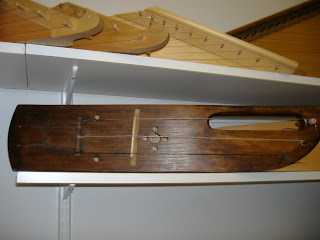
And more recently, we learned about the jouhikko. It is 3-stringed and played with a bow and the bottom of it is held between your legs (in the way you would hold a cello). It's really interesting because you have to hold onto it with your left hand (where there's a space in the wood-see above). And you only change the pitch on the string farthest to your right; the other 2 are drones. BUT, instead of putting your fingertips down on the string to change the pitch, you have to move the bottom joint of your left-hand fingers (except for the thumb, which is still holding on) backwards to touch the string. It's really counter intuitive if you grew up playing a violin or cello or guitar (for instance). Also, the bow is used to create a back beat feel, where the drone strings are emphasized on the 2nd and 4th beat. I hope to make a jouhikko in the instrument making workshop spring semester. This, I really WILL practice!


Another intriguing part of Finnish folk music is joiking. It originates from the Sami people in Lapland. When you joik, you're basically singing or chanting on something. For instance, you can joik on your dog or on the tree you just walked by or whatever. It's a way to represent, right now, how you are feeling about or experiencing something. The Finnish band: Rinneradio has a track on their album 'On' that is called Slow Travel, Part 1, which features joiking. Check it out!

The Sibelius Academy has one of the only Folk Music departments in the entire world. It emphasizes playing of Finnish and international folk styles, with less focus on research than an ethnomusicology program. I'm grateful to have had such a great opportunity to learn about Finnish folk music.


KØBENHAVN- My trip to Copenhagen


Nyhaven Canal


In mid-November, I took a long weekend trip to visit my friend Raj. He is also on a Fulbright Scholarship, but at the Royal Danish Academy of Music in Copenhagen. I had a great time in the city and am surprised that it's not a more popular tourist destination for Americans-maybe it's still somewhat undiscovered, especially since Amsterdam is relatively closeby and more of a hot spot for Americans.

One of the best things about the trip was that I could go to a variety of ethnic food restaurants and it didn't cost me an arm and a leg. In Helsinki, things are very expensive and the only ethnic fast food you can get is a kebab. This does get old after a while. In Copenhagen, I went to a Tex-Mex place, an Indian restaurant, a middle-Eastern vegetarian buffet, an Italian restaurant and a Danish cafe.


Tivoli Gardens was one of my favorite places in Copenhagen. For some reason, I expected it to be like the state fair amusement parks in the US: with unhealthy food and sketchy looking guys running the rides. Or, at least, I expected it to be like Six Flags: cool rides but very plastic and fake. At Tivoli, it did cost a lot to get in and then you still have to pay for each ride, BUT, it was such a classy, artistic place. I went at night and the Christmas lights were up. The rides and surrounding buildings were beautiful. It was a very artistic amusement park experience. I highly recommend it. Tivoli hosts regular outdoor and indoor performances and there are nice restuarants on the grounds, as well. Actually, as I was sitting drinking some Glögg (red wine that is heated and spiced with cinnamon, sugar, cloves, etc), there was a group of high school-aged kids performing Christmas carols on brass instruments and strolling through the grounds. The best part was that they were wearing clogs, so they made quite a racket as they walked from place to place.


My last day in Copenhagen, Raj and I took an excursion outside of the city to Kronborg Castle. It is also known as Elsinore, the setting for Shakespeare's Hamlet, Prince of Denmark. We were running a bit late and didn't get there in time to go on a tour, but we got a good feel for the place anyway. We then went to the Louisiana Museum of Modern Art, which I really enjoyed. The organization and layout of the exhibitions as well as the collection was well done. It's one of the best art museums that I've been to.

Visiting Copenhagen gave me the breath of fresh air that I needed to then go back to Helsinki and have a productive end to my semester. I hope you all have a chance to visit it someday.

Friday, November 28, 2008

Cultural Exchanges-Fish, Pumpkins, and Ice-Cold Lakes

I have had several interesting and unique experiences that I could only have experienced in Finland. I have also, consequently, been able to share a bit of my culture with others. Here are a couple of examples.


First up, the Baltic Herring Market. Once a year, this market sets up stands for a couple of weeks in late Sept/early Oct. Besides herring, you can also get salmon and muikut, tiny fish that look like minnows and are eaten whole after being sauteed with salt and other spices. My friends, Trevor and Ingo, and I got a combination platter of the above 3 fish served with potatoes, fresh and warm from one of the food stands. Also for sale was pickled herring in a variety of sauces, as well as Tyrni products, yellow/orange-colored jelly and juice that is made from sea-buckthorn berries and is made in western Finland. For dessert, we had a Finnish pancake/crepe-like thing, Pannukakku. It was delicious. This was definitely a uniquely Finnish experience. Well, I've never been to a Baltic Herring Market in the US, at least.


Halloween. This was a way for my American friends and I to show the other exchange students what Americans do on Halloween. Most of the exchange students I know are German-speakers, predominantly from Germany, but also from Austria and Switzerland. Everybody got dressed up and there was pumpkin-carving (something new to the non-Americans), punch, food, pumpkin seed roasting and finally, a viewing of 'The Shining'. These were all very Halloween-appropriate activities and I had a great time.

Pirates!


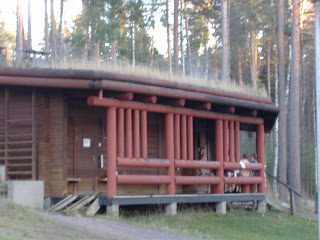
And finally, Finnish Sauna!! This was an extreme sport-like experience. I'm not even joking!! A bunch of my friends and I trekked up to a public wood-heated sauna (supposedly much better than the electric saunas that most people are familiar with). To me, it felt less dry and smelled smokier than electric saunas. The public aspect of this sauna experience ended up being slightly problematic, mainly because all the other people there were Finns with the most ridiculously high tolerance for heat. I honestly had to stand in the entrance the whole time because if I'd gone up higher to sit, I problably would have burnt my lungs or something. It was nuts. Basically, when you want to heat up the sauna more, you throw water on the hot stones. If it's already quite hot, you get the sensation that your flesh is burning. It's sort of addicting once you get used to it but painful if you're not. Anyway, the Finnish men in this sauna must have won some award for withstanding the hottest saunas ever (actually I did see one guy afterward with a Sauna Olympics T-shirt), because they were constantly throwing water on the stones. I think the Finns figured out that if they wanted to get us out of the sauna, they could just throw more water on the stones, because we definitely went running whenever they did.


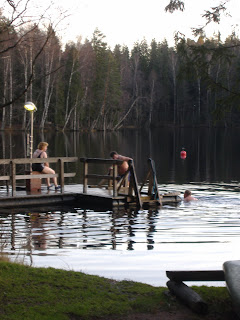
Anyway, once you are thoroughly heated up, you either go sit outside (mind you, this is November, so it was pretty cold outside) or, even better, go jump in the lake right next to the sauna (an even colder experience). Of course, my whole reason for going to this particular sauna was to do the lake swimming as well. That is the coldest water I've ever been in. I'm guessing it was 40-50 degrees Fahrenheit, although I honestly don't know. And get this, there was a separate area in the lake where people would go just to swim laps, without even going in the sauna first. This convinced me that Finns have some supernatural resistance to cold. Anyway, I did the back and forth sauna-lake thing about 3 times and was done. I was quite proud of myself for withstanding both the heat and the cold. And afterwards, I felt as though I'd just gone on a 5 mile run. This is the real benefit to doing a sauna/swim, it gives your body a real workout without your having to do much actual exercise.....something about your pores being opened by the heat and then quickly closed by the cold, and also your heart having to work hard to pump blood to your body once you're in the water.


Although I'm making this Finnish sauna thing sound scary, I think it's very healthy. I'm not excited about doing lake swimming anytime soon, but I try to go to sauna (as they say it here) at least once a week and I feel so much better afterwards. It's also good for your skin, as you can tell when you notice that Finnish people have very nice skin. Although saunas are not nearly as plentiful in the US, I hope to keep up this sauna habit when I go back.

Tuesday, November 25, 2008

Turku and the American Voices Seminar


October 17-18 2008, I spent some time in Turku, Finland during the American Voices Seminar at the University of Turku. The Seminar gathers together the current American Fulbright grantees and scholars and asks each person to give a 20 minute presentation on any topic related to the US. There were 16 of us altogether and the presentations took up about 3 hours on both Oct. 17 and 18.


My topic was American fiddling styles and I talked about and played examples of Bluegrass, Appalachian and Acadian fiddling styles. I also explained about my experience playing in a Contradance band in Connecticut and ended with a short piece by Mark O'Connor that demonstrates a blend of fiddling styles with western-classical playing techniques. It was not only great to develop a presentation on something that really interested me, but it was also nice to hear what everyone else came up with for their topics. This was definitely an academic experience.


In between the hours of presentations, I also got a chance to see some of Turku. Turku is on the southwestern coast of Finland and is a good departure point if you want to take a ferry to Stockholm. It is supposedly the oldest city in Finland and was the capital when Finland was under Sweden's rule (from the 13th century up until 1809). Finland is bilingual, with both Finnish and Swedish the official languages. Although the majority of people in Finland have Finnish as their mother tongue, native Swedish speakers comprise 6% of the population. The Swedish-speaking minority lives mainly in the western part of Finland and hence, there are a sizable amount of Swedish-speaking Finns in Turku.


Although much of Turku was rebuilt after the Great Fire of 1827, there are still some remnants of old Turku, most notably the Cathedral of Turku and the Turku Castle. I didn't get a chance to see the Castle, but walked by the Cathedral many times.


I also took a pleasant walk along the Aura River. There is a beautiful path alongside it.


It was great to get out of Helsinki for a while to discover a new city. It was also nice to meet up with the other Fulbrighters. This led to lots of story swapping, especially about our numerous fun yet silly mishaps as newcomers to Finland. The camaraderie we've developed has been a real comfort to me while in Finland.

Monday, October 27, 2008

A Walk around Töölönlahti (Töölö Bay)

Töölönlahti is centrally located in Helsinki. Because it is near the Sibelius Academy, I often find myself in its vicinity. There is a great walking path around it and I took some pics of it and interesting places near it the other day.


This is the Olympic Stadium, which hosted the 1952 Summer Olympics. It was supposed to host the 1940 Olympics, but it was cancelled due to World War II. This is where I go for my salsa classes. And there's also a youth hostel here.


The City Winter Garden. A good place to relax.


Nice view of the bay. The building in the distance is the Finnish National Opera (Kansallisooppera).


My favorite trees.


And finally, Kiasma, the Museum of Contemporary Art. The words on the building say something to the effect of: 'I don't quite get it', which I think is great, since many people find contemporary art difficult to understand.

Monday, October 20, 2008

The Finnish Language

Ever heard this tongue twister?


How much wood would a woodchuck chuck if a woodchuck could chuck wood?
As much wood as a woodchuck would if a woodchuck could chuck wood.


Okay, so the Finnish version of this is even better.

-Kokoo kokoon koko kokko.
-Koko kokkoko?
-Koko kokko.


The translation:

-Pile up together the whole bonfire.
-The whole bonfire?
-The whole bonfire.


Isn't this great?!


The above Finnish tongue twister showcases one of the more unique aspects of the Finnish language: double consonants and double vowels are actually pronounced. For instance, in the first word kokoo; in order to pronounce it correctly, you have to spend more time saying the last part of the word. You have to make the 'oo' last longer, time-wise, than the first 'o'. And then take kokko: to make sure you're pronouncing the double 'k', you almost have to make a stop between the first and second 'k'. You can try looking at it like 'kok ko'. Of course, it is difficult to fully understand this unless you have an aural example, which I don't know how to upload. But, hopefully you get the idea.


Also, an important and unique thing about Finnish is that the first syllable of every word is stressed. This creates an interesting rhythm when you listen to the language. If this is hard to imagine, think of saying the words 'banana', 'america', and 'vacation' with the stress on the first syllable: 'BA-nana', 'A-merica', 'VA-cation'. Make sure you pronounce the vowels the same as you normally would, but just emphasize the beginning of each word. Well, every single word in Finnish is treated like this.


Finnish is also a gender free language. For instance,

1) There is no word for he or she- there is just hän.

2) There are also no gender specific articles that are associated with a noun. The noun stands alone. For instance, in German, there are 3 definite gender articles: 'der' (masculine), 'die' (feminine) and 'das' (neuter). das Buch= the book, and because 'das' is the article that accompanies it, 'book' has a neuter connotation. die Frau= the woman, and it makes perfect sense that the feminine article would accompany this noun. Many western European languages use gender specific articles; Spanish, French, German, Italian. However, Finnish and English don't.


In closing, I think Finnish is an amazing and really interesting language. I'm currently taking a Finnish class in an attempt to eventually understand and speak it and I plan to continue next semester with my Finnish class. However, I'm not going to lie, I sometimes feel like this:


when I try to pronounce even the most basic words in Finnish.